
Reservé el vuelo como quien compra unos auriculares con cancelación de ruido: por pura desesperación de silencio. En mi feed aparecían una y otra vez fotos de una bahía mediterránea de arena pálida, con luz suave de la mañana y tumbonas medio vacías, que prometían la escapada tranquila que estaba segura de por fin merecer. Parecía el tipo de lugar donde el tiempo se ralentiza, donde podría escuchar mis propios pensamientos sobre nada más que el sonido de la marea. Sin embargo, para la segunda noche de mi viaje estaba escuchando cánticos de una marcha antiturística que resonaban por el callejón frente a mi alojamiento. No era el silencio que había imaginado, pero resultó ser algo que necesitaba más.
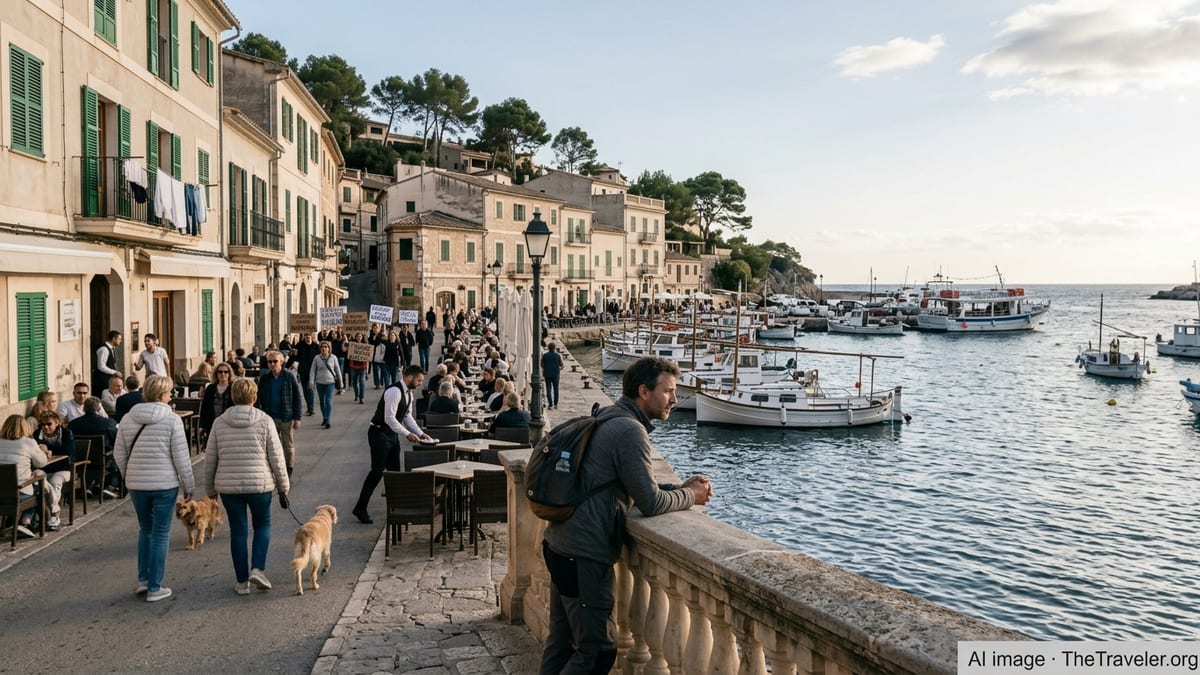
I went looking for a quiet beach getaway and instead ran headfirst into crowds, protests and my own expectations. Here is what the trip changed.
The Promise of a Perfectly Quiet Bay
The destination I chose was a small coastal town on the island of Mallorca in Spain, a place that travel magazines and social media accounts had recently crowned as an underrated, more tranquil alternative to the island’s party-heavy resorts. In the photos, the bay looked nearly private: a crescent of water framed by pine trees, a handful of fishing boats, a stone promenade with just enough cafes to keep you caffeinated between swims. Article after article hinted at “old Mediterranean charm” and “a slower rhythm” if you visited in late spring or early autumn, when school holidays were over and cruise ships supposedly diverted elsewhere.
I picked dates in mid-October, comfortably outside the traditional summer peak. A budget airline ticket from New York via Barcelona came to a little over 600 dollars round-trip, not cheap but still a fraction of July prices I had tracked a few months earlier. A small apartment near the waterfront, advertised as “a peaceful, local neighborhood home,” cost about 95 dollars a night. I pictured myself walking down to the water with a paperback and a light sweater, maybe needing to share the sand with a few retired couples and remote workers, but little more.
From the moment I landed, the narrative seemed on track. The plane was half full. The rental car line at Palma’s airport moved quickly. The drive north out of the capital threaded through quiet farmland and low stone walls, not traffic jams. It was only when the road curved into the bay itself that the discrepancy between promise and reality appeared. The waterfront was dense with people, even on a weekday afternoon in October. Terrace tables were packed, rental bikes filled the promenade, and a throng of hikers with trekking poles queued for a shuttle into the nearby mountains. My off-season haven, it seemed, had read the same glowing articles I had.
When “Off-Season” Is Still Peak
I had fallen into a common modern travel trap: assuming that shoulder season would guarantee solitude. Tourism boards and travel blogs often promote late spring and fall as the sweet spot, when weather is still pleasant and crowds supposedly thin. In many places that holds true, but in parts of the Mediterranean, and especially in islands like Mallorca, those “shoulder months” are now busy in their own right as travelers chase cheaper flights and milder temperatures. Locals I spoke with at a bakery near the harbor told me that October used to feel sleepy, with some hotels closing and restaurants shortening hours. In recent years, though, they said, visitors stayed longer, and many northern Europeans had begun spending weeks or months at a time in rental apartments instead of coming only in July or August.
The signs were everywhere once I started paying attention. The modest two-lane road that fed into town had parking squeezed along both shoulders, despite big new signs asking drivers to use park-and-ride lots. The supposedly quiet hiking trail into a nearby UNESCO-listed mountain range had a reservation system in place, and still felt like a slow-moving queue at more popular viewpoints. Many waterfront restaurants had “fully booked” notices handwritten in several languages, even on Tuesday nights. A bar owner told me that mid-October weekends now felt like “a softer summer,” with airlines and online platforms keeping demand high long after local schools resumed.
That first evening, walking the waterfront, I caught snippets of the same surprise in other travelers’ conversations. A couple from Germany compared the scene to their August trip, insisting it was only marginally calmer. A solo traveler from the United Kingdom, there to work remotely for a month, complained that cafes were too busy to reliably find a quiet corner. I felt a little foolish; I had trusted a mental image built from carefully framed photos and aspirational captions, and ignored subtle signs that my idea of quiet was no longer the industry’s idea of “off-season.”
A March Outside My Window
The real pivot in my trip came on the second night. I was finishing a late dinner in my apartment, windows open to let in what little breeze threaded between buildings, when I heard chanting moving up from the waterfront. At first it was a distant murmur, the same kind of crowd noise that had been my background soundtrack since arrival. Then it grew clearer. I stepped onto the balcony and looked down into the narrow lane. A group of several dozen people, many carrying signs, was walking slowly up the hill, flanked by neighbors leaning out of windows to watch.
Only a few of the placards were in English, but the message was unmistakable. There were slogans about housing getting too expensive for residents, complaints about short-term rentals pushing locals out of town centers, questions about who the island “belonged” to. I recognized some phrases I had seen in news coverage about larger anti-tourism protests in Spanish cities like Barcelona, San Sebastián and Palma earlier in 2024, where residents took to the streets over rent increases and clogged historic centers. This was not a massive march, more a neighborhood-scale expression of those same frustrations, but it was pointed. One sign read, in rough English, “Tourist in bed, neighbor in van,” referencing reports of locals in parts of the Balearic Islands sleeping in vehicles because they could not afford apartments.
I had read about overtourism before as an abstract problem affecting other people’s destinations. Seeing locals in my own temporary street protest the precise existence of travelers like me was uncomfortably direct. I could count at least three short-term rentals in my building alone, identifiable by key boxes and laminated Wi-Fi codes taped discreetly near the doors. It did not take much imagination to realize that the 95 dollars a night I was happily paying could easily outpace what a working local could afford. The peace I had craved was, in part, predicated on a housing market tilted in my favor.
For the first time, I found it hard to slip into my usual travel routine of early walks and late terrace coffees. Instead, I lay awake that night, the chant still ringing faintly in my ears, asking myself why I had been so fixated on finding a place that would cater to my desire for stillness without considering what that quiet cost the people who lived there all year.
Learning to Look Beyond the Postcard
The next morning, I did something that would have seemed unimaginable at the planning stage: I left the beach. I drove inland, following a winding road away from the resort towns into a middle-of-the-island landscape of small farms and low, honey-colored villages. My only real research for this detour came from a barista who had shrugged the day before and said, “If you want calm, go where there is nothing to photograph.” It was only half a joke.
What I found there was the kind of quiet I had been chasing, but in a completely different key. Instead of dramatic cliffs and turquoise coves, there were sleepy town squares with older men reading newspapers, corner groceries selling local cheese and olives, and cafes where tables were occupied but not performing for anyone’s social feed. A simple lunch of pa amb oli, the local bread rubbed with tomato and topped with olive oil, cheese, and cured meat, cost less than a beach cocktail back in the bay. No one handed me an English menu. No one talked about sunrise spots.
In one inland town, I visited a small weekly market selling vegetables, handmade soaps, and work clothes. A vendor, after hearing my accent, asked if I was staying nearby. When I explained I was at the coast but wanted a break from the crush, he smiled sadly and said that more visitors were doing the same. “For us,” he added, “this is still normal. For now.” It was a gentle reminder that even this quieter interior was not immune to the ripples of global tourism. Already, a few tastefully renovated townhouses advertised “authentic village stays” in multiple languages.
Yet the day inland helped me understand that what I was really searching for was not empty space so much as places that still felt like themselves first and a destination second. It also nudged me to reconsider my role as a traveler. If I wanted peace, maybe I needed to pursue it in ways that aligned with, rather than undermined, the lives of people whose home I was visiting: choosing smaller, locally run guesthouses instead of waterfront apartments, splitting my time between popular highlights and under-visited towns, traveling in genuinely low months and accepting that some services would be closed.
Redefining What a “Restful” Trip Means
Back at the coast, I adjusted my expectations instead of continuing to fight the reality around me. I stopped looking for a practically private cove and started looking for pockets of calm in crowded places. That meant early morning walks around the bay before the first group tours arrived, when the only sounds were the scrape of chairs on stone and the clink of coffee cups as cafes opened. It meant swimming in the harbor at lunchtime, when many visitors were eating and the water momentarily emptied, rather than trying to claim the main beach at midday.
I also scaled back my list of “must-sees.” Initially, I planned to drive to several famed lookout points in the mountains, each repeatedly tagged on social media. After watching traffic backups on the narrow coastal roads and reading about trail erosion from heavy use, I chose one less-publicized route instead: a shorter hike from a small inland village to a modest viewpoint over terraced fields and almond trees. The trail was not empty, but there was room to step aside and listen to the wind without feeling like part of a procession. In the end, that single, quiet hour looking down over stone walls and dry fields did more for my frayed nerves than any of the postcard cliffs I had initially bookmarked.
One evening I joined a local walking tour, not along the waterfront, but through the older residential backstreets, guided by a woman who had grown up in the town. She did not dwell on scenic views. Instead, she pointed out shuttered grocery stores and former family homes now converted to holiday rentals. Her commentary was not anti-visitor; she acknowledged that tourism brought income and jobs. But the nuance was clear: for her, a peaceful town was one where young people could afford to stay, where there were still year-round neighbors to greet on the street, where the rhythms of school runs and market days did not disappear under a blanket of seasonal demand.
The Takeaway
By the time I flew home, I had not had the silent, restorative week I had envisioned. My days were filled with adjustments and compromises: waking earlier, walking farther to find quieter corners, making spontaneous decisions when the places I wanted to see were busier than expected. Yet I left with something arguably more useful than a perfectly calm vacation: a sharper understanding of how my search for tranquility intersects with the pressures facing many destinations today.
This trip taught me that a peaceful escape is not only about destination choice but about mindset and responsibility. It is about accepting that places which look pristine and empty in photos might actually be living through a complex moment of popularity, housing stress, and protest. It is about recognizing that you cannot consume “local charm” without affecting the locals themselves. And it is about seeking rest in ways that do not require someone else to give up their own peace of mind to provide it.
Will I still look for quieter corners in the future? Of course. I might choose genuinely low-season weeks, even if that means cooler water or shorter days. I will think harder before booking an apartment in an old town that has seen rents spike. I will put more time into finding inland villages or alternative regions that welcome visitors outside the headlines. Most importantly, I will hold my expectations more lightly. Sometimes the most valuable thing a trip can offer is not escape, but a better way of showing up in the world when you return.
FAQ
Q1. How can I tell if a “quiet” destination is actually crowded most of the year?
Look for signs like year-round flight schedules, frequent cruise ship stops, and local news about housing or tourism protests. These often reveal that so-called shoulder seasons are now busy in their own right.
Q2. What research should I do before booking an off-season beach escape?
Check recent traveler reports, local newspapers, and official tourism board updates about visitor numbers, new regulations, or reservation systems for popular hikes and beaches. This gives a more realistic sense of current crowds.
Q3. Are inland towns really that much quieter than coastal resorts?
Often they are, especially in regions where the coastline has become highly developed. Inland villages may still see visitors but usually keep more of their everyday rhythm and fewer large tour groups.
Q4. How can I travel more responsibly in places affected by overtourism?
Choose locally owned accommodation, travel in genuinely low months when possible, support neighborhood businesses beyond the main tourist streets, and respect local rules around noise, parking, and protected natural areas.
Q5. Is it okay to stay in short-term rentals in historic centers?
It depends on local context and regulations. In some cities, short-term rentals contribute significantly to housing shortages. Checking local guidelines and considering alternatives like small family-run hotels can reduce pressure on residential neighborhoods.
Q6. What if I need rest but can only travel during popular dates?
Focus on how you spend your time rather than expecting an empty destination. Wake early, visit major sights at off-peak hours, build in quiet activities like walks in less central parks, and allow for downtime in your lodging.
Q7. Are there benefits to choosing destinations that are not trending online?
Yes. Less-hyped regions often offer more authentic everyday life, lower prices, and fewer infrastructure strains, while still providing memorable landscapes, food, and culture.
Q8. How can I spot marketing language that might be misleading?
Phrases like “still a hidden gem” or “undiscovered” in widely circulated English articles can be red flags. Cross-check with multiple sources and recent photos that show crowds as well as scenery.
Q9. Does traveling in low season always mean bad weather and closed services?
Not always. In many places, truly low months simply mean cooler temperatures or shorter days, with enough open restaurants and attractions to enjoy, especially in larger towns and cities.
Q10. What mindset shift helped you most on this trip?
Letting go of the idea that a good trip must match the postcard in my head, and instead asking how I could fit respectfully into the place as it actually was, crowds and all.