
Para la tercera semana de mi viaje “barato” por Europa, estaba sentado al borde de una litera de hostel en Múnich, mirando la app del banco con esa lenta sensación de vacío en el estómago: me iba a quedar sin dinero antes de que se acabaran los días. Los almuerzos en cafés, los billetes de tren de último minuto y un par de vuelos baratos impulsivos se habían comido silenciosamente mis ahorros. Se suponía que me quedaban tres semanas más para deambular desde Europa Central hasta España. Al ritmo que llevaba, me quedaban unos seis días. Algo tenía que cambiar, y rápido.
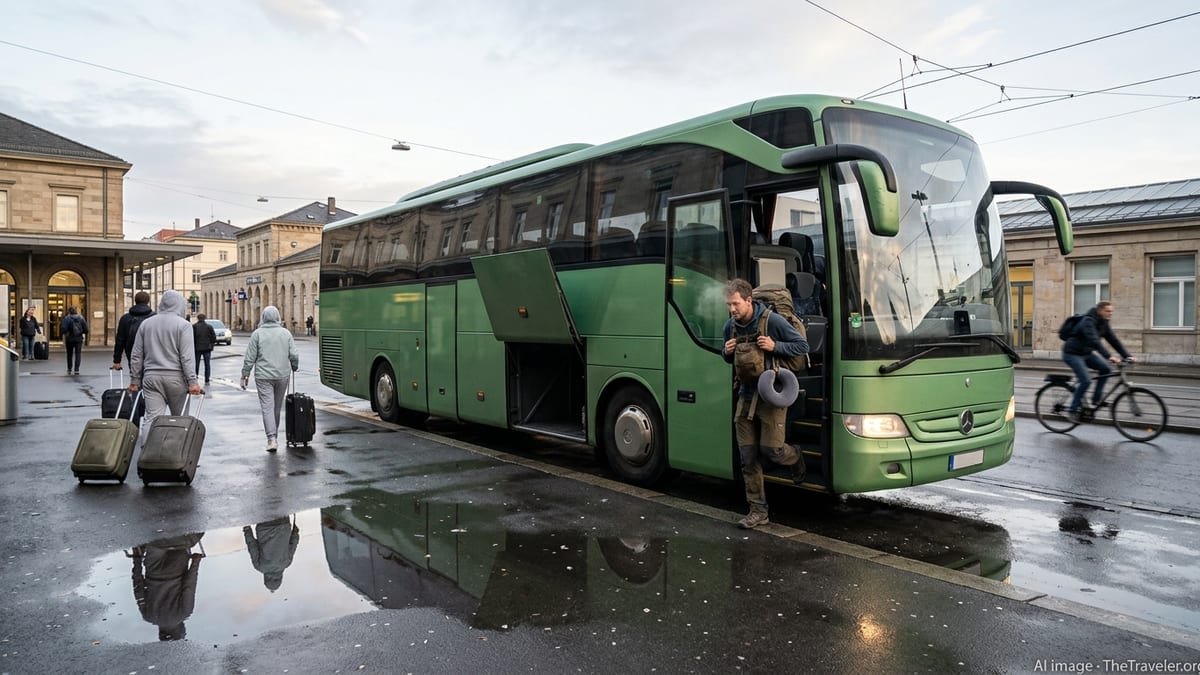
On a shoestring across Europe, I was burning cash fast. One unglamorous decision about transport turned the trip around and kept me on the road.
When My Europe Budget Blew Up
The original plan looked so reasonable when I sketched it out at my kitchen table back in the United States. Berlin to Prague, Vienna, Budapest, Munich, then on to Paris and Barcelona. I had read that you could travel Europe for “€60 a day” and believed it a little too literally. I booked a couple of flexible train tickets, one cheap flight, and assumed the rest would somehow sort itself out.
Reality arrived before I even left Germany. A last-minute Berlin to Prague train, bought just two days before departure, cost me around €70 in second class. A few days later, a spur-of-the-moment flight from Budapest to Munich that had looked so tempting at “from €29” ended up closer to €95 once I added a small checked bag, priority boarding to keep my backpack with me, and the airport transfer on each side. By the time I reached Munich, my transportation budget was nearly half gone and I had only covered a handful of cities.
Meanwhile, my daily costs were creeping up. Hostels that had averaged €22 a night in Prague and Budapest jumped to €30–35 in Munich. A basic lunch that had been €6–8 in Budapest became €12–15. I was not living extravagantly, but I was making every classic mistake: booking late, moving too fast, and assuming that trains and planes were the only “real” ways to get around Europe.
On that rainy afternoon in Munich, I added up what it would cost to continue the trip the way I had started. Even with rough math, the answer was brutal. I could either cut the trip in half or radically change how I moved between cities. That was when a French backpacker in my dorm asked a question that changed everything: “Why are you not just taking the bus?”
The Unsexy Choice That Saved the Trip
Up to that point, I had mentally filed long-distance buses under “student-only misery transport.” I pictured cramped seats, endless delays, and questionable rest stops. In my head, Europe was meant to be crossed by sleek high-speed trains and quick flights, not buses pulled from an interstate somewhere in the American Midwest.
But that night, I started checking actual numbers. A Munich to Zurich train for the following week was showing at around €60 for a reasonable time of day. The same route with a major bus company was listed from roughly €18–25 if I was willing to book a few days ahead. Munich to Paris by train, booked late, was hovering around €120. The overnight bus for the same date: fares starting around €35–45 with Wi-Fi, power outlets, and a toilet on board. Similar patterns appeared again and again: where a train or last-minute flight could bleed my budget, buses sat quietly on comparison sites with prices in the teens and twenties instead of fifties and hundreds.
Looking at the calendar, I realized that transport was my biggest variable cost. Accommodation was already stripped to basics. Food was negotiable but only to a point; you still have to eat. What I could control was how I covered the miles. If I switched to buses for almost every major jump, I could realistically cut my transport spending by 40–60 percent over the rest of the trip. It felt unglamorous, but it also felt like the difference between going home early and actually reaching Spain.
That was the choice. I decided then that for the rest of the trip, buses would be my default, and everything else was the exception. It was not romantic. It did not look particularly good on Instagram. But it kept me on the road.
Learning the Bus Game Across Europe
Once I committed, I treated European buses the way you are supposed to treat low-cost airlines: something you use strategically. I downloaded the main booking apps and started plugging in routes several days out. Munich to Zurich. Zurich to Lyon. Lyon to Barcelona. Over and over, the bus came out dramatically cheaper than anything else. A cross-border route that might have cost €70–90 by rail could often be found on a bus for around €20–30 if I booked a week ahead.
I quickly discovered that some companies essentially form the backbone of budget travel across the continent. On one leg, I paid about €22 for a seat on an overnight service from Munich to Paris, compared with more than €100 for a direct high-speed train the same week. On another, I rode from Lyon to Barcelona for just under €25 while friends on a budget airline paid almost double once they added a checked bag and airport transfers. From Berlin earlier in the trip, I met students who had paid about €25 return for a weekend in Prague by booking a month in advance. Those numbers are not guaranteed everywhere, but they are common enough that you start to trust the pattern.
The real mental shift was planning around bus timetables instead of assuming I could go whenever I liked. Early on, I had been choosing my city hops almost on a whim: decide on Wednesday to leave Friday, find a train or cheap flight, and pay whatever it cost. With buses, I reversed it. I looked at the cheapest dates and times first, then built the rest of my plan around them. If the lowest fare from Zurich to Lyon was a mid-afternoon departure on Tuesday instead of Monday, I stayed one more night in Zurich and found a hostel with free breakfast to soften the cost.
Of course, buses are slower. A Munich to Paris train might take around six hours. The overnight bus listed the trip at closer to ten. But I began to count time differently. On the train, I would probably have booked a hostel in each city for the same nights and treated the daytime journey as “lost” time. On the bus, especially at night, the trip itself replaced a night of accommodation. If an overnight ticket was €30 and that saved a €30 hostel bed, the real transport cost was effectively close to zero.
What It Really Felt Like on Those Long Rides
None of this would matter if the experience had been miserable. It was not luxurious, but it was far more manageable than I expected. Most of the modern long-distance coaches I rode had wide, reclining seats, individual reading lights, and USB or standard power outlets. Wi-Fi quality varied, but I could usually at least send messages and download offline maps. On several routes, there were only two seats on each side of the aisle, which meant no dreaded five-seat rows or makeshift extra chairs.
The longest stretch I did in one go was an overnight bus from Lyon to Barcelona. I boarded just after sunset with a sandwich from the supermarket and earplugs already in. By the time we crossed into Spain, the bus was quiet, the air conditioning was set a little too cold, and the only light came from phone screens and highway rest stops. I slept in uneven bursts, the way you do on any overnight transport, but I woke up rolling into Barcelona with the sun coming up over apartment balconies. I checked into my hostel, took a real shower, and realized I had effectively bought both my transport and my night’s stay for less than the cost of a single budget-flight ticket alone.
There were annoyances. One bus from Zurich to Lyon left almost an hour late because of heavy traffic coming into the station. On another route, a scheduled rest stop stretched to 40 minutes without explanation. A couple of times, the Wi-Fi never connected at all. These are the tradeoffs you make when you accept that you cannot have train-speed, flight-quick routes and still pay hostel-level prices for every journey. I kept a small kit packed with an eye mask, a neck pillow that clipped onto my backpack, a warm layer, and snacks. Treating the bus like a movable, slightly unpredictable hostel bed made every trip easier.
The upside went beyond money. On buses, I met people I would never have spoken to on a high-speed train where everyone retreats into noise-cancelling headphones and laptops. On one Paris-bound ride, I sat across from a Portuguese student who scribbled a list of cheap places to eat in Lisbon on the back of my ticket. On another, a retiree from Lyon explained the French obsession with regional trains while sharing a bag of cherries. Those conversations filled the slow hours and reminded me that low-budget travel is not just about cutting costs; it is also about accepting a slower, more human pace.
How One Decision Rewrote My Entire Budget
By the end of the trip in Barcelona, I ran the numbers. If I had continued with trains and flights at the prices I was seeing when I started, my long-distance routes would have cost somewhere in the range of €600–700 for the month. By switching almost entirely to buses and slotting in a couple of well-timed regional trains where they genuinely made sense, I kept that total closer to roughly €350–400.
That difference was not an abstract saving; it showed up as real experiences. It was the tapas crawl in Barcelona that I would otherwise have skipped. It was being able to say yes to a last-minute day trip from Paris into Champagne by regional train because my transport budget had breathing room. It was not needing to count every coffee in a city like Zurich, where prices stack up quickly for anyone paying in euros or dollars.
There were also softer benefits. Knowing that my major intercity costs were under control stripped a lot of anxiety out of the trip. Instead of refreshing flight comparison sites in a panic whenever I wanted to change the plan, I could open a bus app, scan the options for the next week, and adjust my route without breaking the budget. When I did occasionally pay for a train, it was a deliberate choice for comfort or speed, not a default.
The key lesson for me was that seeing Europe “cheaply” is less about any one perfect tool and more about choosing a main strategy. For some people, that might be a rail pass that makes sense for a dense, train-heavy itinerary. For me on that particular trip, it was accepting that the cheapest viable infrastructure crisscrossing the continent ran on wheels, not rails. Once that decision was made, everything else became easier to plan.
Practical Ways to Apply This on Your Own Trip
If I were planning the same route today, I would start by mapping the whole trip around the cheapest transport options instead of squeezing them in later. I would pick no more than six or seven key city stops over three weeks and then check buses first for every leg. On a Berlin to Prague hop, I would expect to find competitive bus fares in the €15–25 range if I booked at least a couple of weeks ahead. From Prague to Vienna or Budapest, I would price out both buses and regional trains, but my default assumption would be that the bus is cheaper unless there is a special rail fare.
I would also look hard at overnight routes. Paris to London, Paris to Amsterdam, Munich to Paris, Lyon to Barcelona, Rome to Milan or Venice: most of these have overnight buses that cost a fraction of a last-minute high-speed train or plane ticket and save a hostel night. I would not pack my schedule with them, but even two or three night journeys on a three-week itinerary can nudge your total costs down in a meaningful way.
One mistake I made early on was jumping at the lowest base fare without checking the total reality of the trip. A €19 flight might look unbeatable until you add a €35 checked bag fee, a €10 airport shuttle on each end, and the time you lose commuting far out of the city. Buses almost always leave from central stations or at least from places linked by metro or tram. When I compared “door to door” times and prices, the bus sometimes arrived only an hour or two later than a flight and cost half as much.
Above all, I would build in a little flexibility. The cheapest fares usually appear on specific days or times, and you get the best deals when you are willing to leave on a Tuesday instead of a Sunday, or take a mid-afternoon ride instead of the most popular evening departure. On my actual trip, agreeing with myself that transport would dictate my calendar for once was strangely freeing. I stopped chasing the perfect itinerary and started following the cheapest roads that still felt sensible.
The Takeaway
When people ask how I managed to stretch my blown budget into a full three weeks across Europe, I tell them the truth: I chose the bus. Not because it was glamorous, not because it matched the romantic idea of crossing the continent by train, but because it quietly did the one thing nothing else could do at that moment. It allowed me to keep going.
There are many ways to see Europe cheaply. You can hunt error fares on airlines, you can swear by rail passes, you can string together rideshares and regional trains. On my trip, the simple decision to make long-distance buses my default changed the shape of everything that followed. It forced me to slow down, to plan a little, and to accept that the cheapest solution often looks ordinary from the outside. Yet it was that unglamorous choice that saved the trip I had dreamed about for years.
If you find yourself sitting on a hostel bunk with your banking app open and your plans unraveling, look first at how you are moving, not where you are staying or what you are eating. Sometimes, the choice that keeps your trip alive is not a new destination or a clever hack; it is just picking the dull green bus over the sleek white train and letting the savings carry you a little further down the road.
FAQ
Q1. Are buses in Europe really that much cheaper than trains and flights?
In many cases, yes, especially if you are booking late or traveling between major cities. While a last-minute high-speed train or flight can easily cost €70–120 for a popular route, long-distance buses on the same corridor often run in the €15–35 range if you book ahead. Prices vary by season and route, but for a strict budget, buses are often the lowest-cost option for intercity travel.
Q2. Are overnight buses safe for solo travelers?
Generally, overnight buses in Europe are considered reasonably safe, and they are used by students, workers, and tourists alike. Safety can depend on the route and operator, so it is sensible to choose well-known companies, keep your valuables on your person, and use common-sense precautions such as locking your bag zippers and staying aware during rest stops. Many solo travelers, including women, use overnight buses without trouble each year.
Q3. How far in advance should I book bus tickets to get good prices?
For most busy European routes, booking at least one to three weeks in advance is enough to secure lower fares, especially outside the peak summer months. On very popular routes or during holidays, it can pay to book even earlier. If you wait until the last couple of days, prices often rise and some departures may sell out, particularly overnight services.
Q4. Are buses too uncomfortable for long journeys?
Comfort is subjective, but modern long-distance coaches across Europe are usually more comfortable than their reputation suggests. Most have reclining seats, air conditioning, onboard toilets, and at least basic Wi-Fi. For trips of six to ten hours, bringing a neck pillow, eye mask, warm layer, and snacks can make a big difference. If you sleep reasonably well in a plane seat, you will probably manage fine on a long bus ride.
Q5. When does it make more sense to choose a train instead of a bus?
Trains are often the better choice for shorter routes, very scenic stretches, or when you value speed and comfort over saving every possible euro. If you can book advance-purchase rail tickets at a good price, or if a trip is only a few hours and the cost difference to the bus is small, the train may be worth it. Rail passes can also make sense if you are taking frequent journeys over a short period and need flexibility.
Q6. Do buses usually leave from city centers?
Yes, one of the advantages of buses is that they typically depart from central bus stations or major transit hubs connected by local buses, trams, or metro lines. This means you often avoid long and expensive airport transfers. Always double-check the departure location in advance, as some cities have multiple bus terminals or suburban stops listed under similar names.
Q7. Can I rely on bus Wi-Fi to work during the whole trip?
Wi-Fi on buses is best treated as a bonus rather than a guarantee. On many routes it works reasonably well for messaging and light browsing, but it can be slow, limited, or occasionally unavailable. For important tasks, download what you need in advance, save offline maps, and carry entertainment that does not depend on a stable connection.
Q8. How do bus delays compare to train or flight delays?
Delays can happen with any form of transport, but long-distance buses are particularly affected by road traffic and border queues. In my experience, minor delays of 30–60 minutes are not unusual on busy corridors. Build some buffer into your schedule, avoid tight same-day connections, and avoid planning nonrefundable activities immediately after arrival when using buses.
Q9. Is it safe to store luggage in the bus hold?
Most travelers place large backpacks and suitcases in the underfloor hold without issues, but it is wise to keep valuables with you in a small daypack that stays on your lap or under the seat. When the bus stops, pay attention as people collect bags, and make sure yours is labeled and distinctive enough to spot quickly.
Q10. How many overnight buses should I realistically plan into a trip?
That depends on your personal tolerance, but for most people, one overnight bus per week is a reasonable upper limit on a longer trip. On a three-week itinerary, two or three well-timed night journeys can save substantial money on both transport and accommodation without leaving you permanently exhausted. Listen to your body and balance night travel with enough proper sleep in real beds.