
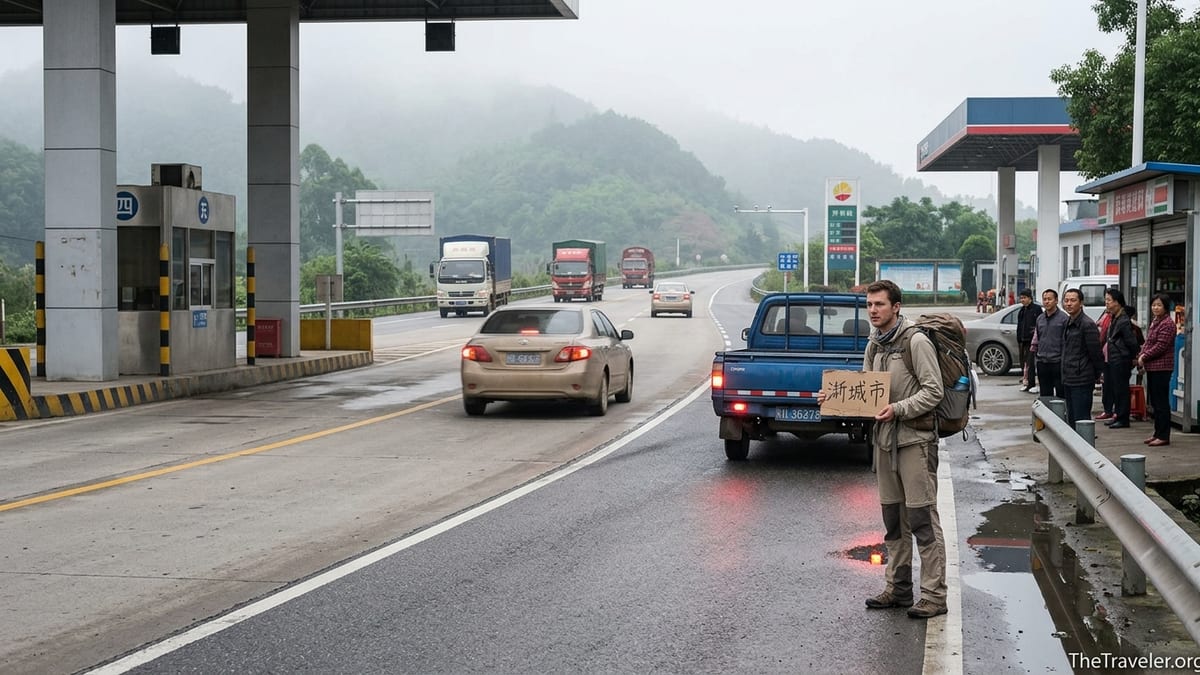
La primera vez que saqué el pulgar al borde de una autopista a las afueras de Chengdu, con la mochila clavándose en los hombros y un trozo de cartón con dos caracteres temblorosos para «Chongqing» en las manos, no estaba intentando ser valiente. Estaba intentando no entrar en pánico. Había leído los hilos de foros, los blogs de autostop y las advertencias sobre barreras idiomáticas y controles de seguridad. Aun así, nada se compara del todo con ese primer momento en la China rural cuando el autobús ya se ha ido, la señal del teléfono es irregular y tu único plan es que algún desconocido en un camión que pasa decida parar. Lo que siguió en las semanas posteriores, en las carreteras entre Sichuan, Yunnan y Guangxi, me enseñó más sobre viajes y confianza que cualquier itinerario cuidadosamente planificado.
Get the latest updates straight to your inbox!
A reflective look at hitchhiking solo across China, how it really works on the ground, and how it reshapes your sense of travel and self-belief.
Is Hitchhiking in China Really Possible?
Before arriving in China, most of what I knew about hitchhiking there came from scattered blog posts and a few academic notes that mentioned it as a niche, youth-driven subculture rather than a mainstream way to get around. On paper, China does not look like an obvious hitchhiker’s paradise. Long-distance buses and high-speed trains connect even mid-sized cities. Tickets from Chengdu to Kunming on a second-class high-speed train can often be found for the equivalent of 60 to 90 US dollars if booked in advance, and sleeper buses tread the same routes overnight for less. For most domestic travelers, it makes more sense to scan a QR code and pay through a phone app than to stand on the roadside with a handmade sign.
Yet out on the ground, especially away from the coastal megacities, the picture is more nuanced. Heavy truck traffic along corridors like the G5 and G75 expressways, and the culture of shared rides in rural areas, mean that hitchhiking is recognizable even if it is not common. I noticed this the first time a minivan driver outside Leshan slowed to stare, clearly puzzled, then broke into a grin as soon as he realized I wanted a lift. The idea was unusual but not incomprehensible. In many parts of China, drivers are used to picking up extra passengers informally near toll booths or village junctions, sometimes for a small contribution to fuel, sometimes just to have company for a lonely drive.
Legally, the realities are more complex. China’s national road safety laws prohibit behaviors that obstruct traffic, and there are explicit provisions against forcing vehicles to stop. Some provinces and cities enforce these more strictly than others. In practice, this means that hitchhiking in the middle of a busy off-ramp or trying to flag vehicles on an expressway hard shoulder is not just dangerous but can draw the attention of traffic police. On one wet afternoon near Dali, officers emerged from a highway service area, waved me away from their preferred patrol spot, and then, after a few confused minutes of translation apps, insisted on driving me to a safer junction closer to town.
Experiences like that sit at the core of hitchhiking in China. It is not a legally defined mode of transport, nor is it outright banned in most places. It lives in the gray spaces of local custom, personal kindness and the discretion of officials. Understanding that from the start does more than keep you out of trouble. It shifts how you think about travel: less like a consumer choosing services, more like a guest navigating someone else’s rules and rhythms.
The First Ride: Fear, Cardboard, and a Highway Shoulder
The first time I tried to hitchhike in China, I underestimated how much the small practical details matter. I left Chengdu on a local bus that dropped me near an expressway toll gate. On my phone I had offline maps, a phrasebook and screenshots of advice that suggested standing just beyond where cars exit the toll plaza so that drivers have already slowed down. What I did not have was a sign in Chinese characters. My hastily scrawled pinyin place name meant nothing to passing truckers.
It took an hour, a cheap marker pen bought from a nearby convenience stall, and the help of the stall owner to rewrite my cardboard sign using the correct characters for Chongqing. The transformation was immediate. Within ten minutes, a small blue pickup pulled onto the shoulder. The driver, a man in his late thirties in worn flip-flops, leaned across the passenger seat and asked where I was from. I understood only the words “nǎ guó” and caught the meaning from his gesture. When I answered, his eyebrows shot up. Then came the question I would hear dozens of times: “Yīgè rén?” Alone?
On that ride, I sat with my backpack wedged at my feet, a seatbelt pressing awkwardly against my jacket and the driver’s dash-mounted smartphone barking navigation instructions. On the radio, soft pop ballads faded in and out as we climbed through low, cloud-wreathed hills. The conversation was a slow dance between translation apps, charades and the few Mandarin words we shared. He wanted to know my age, how much my phone cost, and whether I liked hotpot. I tried to ask how often he drove this route and whether he had ever picked up a foreigner before. He had not.
That first successful lift did not feel like an act of bravery. It felt like relief. Still, when the driver let me out at a service area two hours later, my hands were steady in a way they had not been at the toll gate. Confidence, I realized, rarely arrives as a dramatic surge. It accumulates in tiny, practical victories: finding the right spot, getting a sign written correctly, accepting that the fear will not fully vanish and deciding to raise your thumb anyway.
Reading the Road: How China’s Geography Shapes Hitchhiking
One of the early surprises of hitchhiking in China is how much the road system itself dictates your experience. China’s modern expressways are engineered for speed and efficiency, not for spontaneous roadside encounters. Pedestrians are banned from most sections, and long distances between exits can trap a hitchhiker in the wrong service area for hours. Learning to work with that infrastructure rather than against it is a kind of travel literacy all its own.
In practice, this meant aiming for the pinch points where vehicles naturally slow and decisions have to be made. Highway toll plazas on the outskirts of mid-sized cities like Panzhihua or Baise were often productive, as were petrol stations with a mix of local traffic and long-distance trucks. One afternoon near Kunming, I spent almost three hours at a large fuel stop where drivers queued to top up before heading south toward the Vietnamese border. Eventually a pair of young delivery drivers in a refrigerated van waved me over, laughing at my sign and offering me a ride as far as Honghe. Their van smelled sharply of garlic and green onions from the crates of produce in the back, their dashboard decorated with a tiny waving cat and a faded sticker of a local football team.
China’s extraordinary geographic diversity also colors each segment of the journey. In the lush folds of Yunnan’s rice terraces, narrow two-lane roads snake through hillside villages where goats wander across the asphalt and old men sit outside little shops playing cards. Here, rides came easily. Roadside stalls selling grilled tofu and Yunnan coffee meant I could linger naturally, chatting and waiting for a sympathetic driver. In the industrial landscapes around Chongqing and Wuhan, six-lane arteries and elevated ring roads made hitchhiking far more intimidating. On the outskirts of Xi’an, for example, I abandoned attempts to thumb a lift entirely and instead used a basic ride-hailing app from a mall’s free Wi-Fi to reach a safer spot.
Moving through these regions by hitchhiking is not efficient in the way a high-speed train schedule is efficient. It introduces friction and unpredictability. But that is precisely why it can deepen your sense of place. Watching the countryside roll by slowly from the cab of a concrete mixer truck between Dali and Lijiang, with the driver explaining the local word for each type of vegetable field, taught me more about rural Yunnan than any museum caption ever could.
Language Barriers and the Art of Being Understood
No aspect of hitchhiking in China shapes your confidence quite like language. In major cities, you can often get by with English and translation apps. On the road, especially once you leave provincial capitals, English fades quickly. Drivers who are willing to give a ride are often those who spend most of their days among colleagues who share their dialect and work routines. Suddenly you are the outsider in a space that rarely hosts foreigners.
Before my trip, I had memorized a handful of practical Mandarin phrases: “Can you take me to this city?” “I do not have much money, is hitchhiking okay?” “I can get off anywhere along the way.” Even spoken with awkward tones, they worked surprisingly well when combined with maps on my phone. One truck driver between Guiyang and Guilin scrutinized my offline map for a long minute, then gently corrected my pronunciation of the city name three times before starting the engine. His patience became a small, moving lesson in how generosity on the road often expresses itself in these quiet, instructional moments.
Technology filled many gaps. Quick-draw translation apps that can operate offline or on patchy 4G networks allowed me to type or dictate explanations and then hand my phone to a driver. This felt clumsy at first, as if I were turning a fluid exchange into a series of delayed subtitles. Over time, though, I learned to use the disruption strategically. Pausing to type gave me a moment to think about what I actually needed to say instead of babbling nervously. It turned hitchhiking into a language classroom on wheels, with truck cabs and minivan back seats as mobile study spaces.
There were, of course, misunderstandings. Once, a driver near Liuzhou misread my sign and assumed I only needed a short lift to the next village. When I tried to explain that I was aiming all the way for Nanning, he frowned, pulled into a lay-by and called his cousin on speakerphone to help translate. The cousin’s English was halting but kind. Together they proposed a compromise: the driver would take me as far as Guigang, and from there I could catch a slower local bus the rest of the way. Standing in that lay-by, listening to these two men puzzle out the safest option for a stranger, I felt a kind of vicarious trust that is hard to describe. It did not erase the vulnerability of being dependent on others, but it did reframe it as something shared rather than one-sided.
Each successful conversation, however imperfect, nudged my internal bar for what I believed I could handle. Before China, I would have avoided any travel situation that required real-time negotiation in a language I barely spoke. By the time I reached the karst hills around Yangshuo, I had grown comfortable walking up to a group of drivers at a petrol station, greeting them with a “nǐ hǎo,” pointing at my sign and simply seeing what unfolded.
Safety, Risk, and Knowing When to Say No
Any mention of hitchhiking, especially solo and especially in a country that is not your own, raises immediate questions about safety. It should. On Chinese roads, as anywhere, accidents happen, and personal safety is influenced by everything from traffic density and weather to your own instincts. Over time I came to see that hitchhiking in China does not abolish risk but redistributes it in ways that can be managed with care.
From a purely traffic perspective, some of the biggest hazards I encountered had nothing to do with the motives of drivers and everything to do with road design and conditions. Night-time truck rides through mountain tunnels near Guizhou in heavy rain felt much more dangerous than daytime lifts on quiet provincial roads, not because the drivers were untrustworthy but because visibility was poor and fatigue hung over the cab. I learned to decline night rides on unfamiliar highways, politely asking drivers to let me sleep at 24-hour service stations instead. In one case, a trucker even insisted on paying for a basic bowl of noodle soup at a rest stop canteen before he continued on alone.
Personal safety decisions were rarely dramatic. They played out in small choices: avoiding drivers who had clearly been drinking with friends at roadside restaurants, stepping away from vehicles that stopped abruptly in risky spots, or insisting on sitting in the back seat when a ride felt slightly off. On a humid afternoon outside Guilin, a car full of young men pulled over with loud music blasting. They were talkative and friendly, but there was a restless energy in the way they jostled each other and joked. I thanked them, said my destination was actually in the opposite direction, and let them drive on. Ten minutes later, a middle-aged couple in a family sedan stopped instead. The ride may have taken longer to appear, but it felt right.
Encounters with police or local officials were usually shaped by curiosity rather than hostility. China’s security environment is carefully managed, and foreigners staying overnight are required to be registered with local authorities. Traveling in this context means accepting that you may be questioned more often than you would be at home. Once, after a truck driver dropped me near a small town in Guangxi, two officers on a motorbike pulled up and asked for my passport. They were polite but firm, wanting to know where I was staying and how I had arrived. When they learned I had hitchhiked, one shook his head slowly, then pulled out his own phone to look up a budget hotel and pointed me toward it. The subtext was clear: your experiment is interesting, but you still need to fit inside our systems.
Learning to say no, to walk away from a ride or change plans entirely, became a crucial safety skill and, surprisingly, a key source of confidence. It reminded me that hitchhiking is a negotiation rather than a favor you must accept with gratitude at any cost. Each time I chose the slower, safer option, I reinforced the idea that my wellbeing mattered more than keeping the adventure alive at all times.
Generosity on the Road: Small Encounters, Lasting Lessons
For all the logistical puzzles and occasional tensions, what I remember most vividly from hitchhiking in China are not the rides themselves but the human gestures that surrounded them. These moments, scattered across truck stops and village crossroads, challenged some of my quiet assumptions about both caution and kindness.
There was the roadside fruit seller near Honghe who, seeing me rejected by a succession of drivers in a sudden downpour, dragged a plastic chair under her striped awning and poured steaming green tea into a chipped mug. She introduced me to every customer who stopped, explaining that I was trying to reach Jianshui. When a woman in a small SUV finally agreed to take me part of the way, the fruit seller tucked two mandarins into my jacket pocket with a matter-of-fact “lù shàng chī,” something to eat on the road.
There was the construction foreman outside Panzhihua who insisted on buying my lunch at a simple roadside restaurant, gently scolding me about not eating enough meat if I was going to walk so much. He ordered a spread of twice-cooked pork, stir-fried greens and a large bowl of rice, then quizzed me on my chopstick technique. Afterward he organized with one of his drivers to detour slightly and drop me closer to the next highway junction, refusing to accept even a token contribution to fuel.
Not all generosity took the form of material help. In Yuxi, a university student who spotted me trying to decipher bus schedules at a suburban station walked with me to the edge of town, explained where local drivers heading toward Kunming usually stopped for cigarettes, and wrote a new sign in large, neat characters. Before leaving, she added her WeChat contact, instructing me to message her once I found a ride so she would know I was safe. That simple request for confirmation, in a city where we had met entirely by chance, felt like an anchor.
These examples are not meant to romanticize China as uniquely hospitable or to suggest that kindness erases structural challenges. Instead, they highlight how hitchhiking amplifies the role of everyday generosity in travel. When you move by thumb and sign rather than ticket and timetable, your days are stitched together by small acts of care from people who owe you nothing. Accepting that care without entitlement, and learning to reciprocate in small ways, becomes a quiet training ground for humility.
How Hitchhiking Rewires Your Sense of Confidence
Before hitchhiking in China, I tended to equate travel confidence with preparation. I felt secure when I had printed tickets, confirmed bookings, clear hotel addresses and backup plans stored in my email. China’s vastness and digital ecosystem already nudges visitors out of that comfort zone: train tickets purchased through local apps, transport cards loaded with mobile payments, hotel check-ins that rely on face scans and police registration. Choosing to hitchhike inside that environment multiplies the uncertainty tenfold.
What I discovered, though, is that navigating this uncertainty does not require the absence of fear. It asks instead for a different relationship with it. Standing outside a gas station in southern Sichuan at dusk, knowing that if no one stopped I would have to walk several kilometers back to the nearest village, I felt the familiar spike of anxiety. But repeated experiences had taught me that something usually did work out: a ride, a cheap guesthouse, a friendly shop owner who let me charge my phone and pointed me toward a minivan stand. Confidence emerged not as a belief that “nothing bad will happen,” but as a kind of practiced trust in my own ability to improvise when things did not go according to plan.
This shift carried over into more conventional parts of the trip. When I later boarded a crowded overnight hard-sleeper train from Guilin to Guangzhou, I found myself less fazed by the noisy corridors, the unfamiliar layout of the bunks and the gruff ticket inspectors. After negotiating rides with truckers, explaining my hitchhiking experiment to curious police officers, and finding last-minute beds in small-town guesthouses that barely advertised online, a printed train ticket suddenly felt like a luxury.
Hitchhiking also reshaped my sense of social confidence. Approaching strangers, where I had once hesitated even to ask directions in my own language, became a daily necessity. Some drivers said no. Some laughed, some waved apologetically, some ignored me entirely. Learning not to take these reactions personally was as important as celebrating the yes answers. When you hitchhike, you begin each day fully aware that no one is obliged to help you. Over time, this awareness can soften both entitlement and self-consciousness in ordinary interactions long after the journey ends.
Perhaps the most unexpected transformation lay in how I related to my own limitations. Hitchhiking made those limitations obvious: I could not speak fluently, I could not control the weather or traffic, I could not always predict which plans would hold. Instead of viewing these as failings, I began to see them as part of the shared human condition on the road. Every driver who hesitated over my sign was also juggling fatigue, deadlines and family obligations. My confidence became less about mastering everything and more about accepting that I could still move forward despite never fully being in control.
Practical Lessons for Travelers Considering Hitchhiking in China
While hitchhiking is not the right choice for every traveler, the lessons it offers can still inform how you move through China even if you mostly rely on trains and buses. Some of these lessons are surprisingly concrete. For example, investing in a reliable SIM card or eSIM that works across provinces, and ensuring you can access basic translation and map functions even with weak data, makes a profound difference not just for hitchhikers but for anyone navigating smaller cities or rural areas. Likewise, carrying a small notebook where you or new acquaintances can write Chinese characters for destinations or addresses can quickly bridge communication gaps.
Another practical takeaway is the value of understanding transport hubs beyond the obvious. Many travelers know that major train stations and long-distance bus terminals serve as gateways to the next destination. Hitchhiking teaches you to look one layer deeper: where do local delivery vans congregate in the early morning, where do commuter buses turn around, where do market traders park their small trucks after unloading? Even if you never raise your thumb, noticing these patterns gives you more options when formal connections are disrupted by weather, holidays or last-minute schedule changes.
For those seriously considering hitchhiking, starting with short segments on well-traveled routes can be a way to test both your appetite for uncertainty and your safety instincts. A half-day attempt between two towns in Yunnan, for example, where guesthouses and bus alternatives are easy to find, will feel very different from trying to cross sparsely populated stretches of Gansu or Inner Mongolia. Solo travelers, and particularly women, will each have their own safety thresholds. Some may prefer to combine hitchhiking with overnight trains and guesthouses that are well reviewed, using the thumb only for scenic daytime stretches where exits and services are frequent.
It is also useful to know what hitchhiking cannot easily solve. It will not necessarily save you much money in a country where slow trains and basic buses remain relatively affordable, especially outside peak holiday seasons. It will not guarantee deeper connections than you might find by lingering for a week in a single neighborhood, frequenting the same noodle shop each morning. What it does offer is a specific kind of engagement with uncertainty and dependence that can, if approached thoughtfully, broaden your understanding of both China and yourself.
Finally, hitchhiking underscores the importance of cultural humility. Learning a few phrases in Mandarin or the local dialect, being aware of basic norms like handing items with both hands and accepting that some people will be uncomfortable hosting a foreigner in their vehicle, even for a short distance, are all small but meaningful ways to show respect. In a country where social and legal expectations around mobility and security are tightly interwoven, your choice to travel in unconventional ways does not exempt you from taking those expectations seriously.
The Takeaway
Hitchhiking solo in China did not turn me into a fearless traveler. Fear still surfaced on dark stretches of highway, in sudden storms at forgotten junctions, and in awkward conversations where translation apps faltered. What changed was my relationship with that fear. It became a signal to slow down, reassess and make conscious choices rather than a stop sign that froze me in place. Each day on the road, from Sichuan’s misty hills to Guangxi’s sharp karst peaks, required a blend of caution and openness that I had rarely practiced so intensely before.
On a practical level, the experience gave me sharper tools: a better sense of how to read maps against real landscapes, how to judge the feel of a ride, how to pick out safer spots at petrol stations and toll gates, how to balance trust with healthy skepticism. On a more personal level, it offered a quieter lesson in confidence, one that had less to do with swagger and more to do with resilience. Confidence, I learned, is often the cumulative result of many small moments in which you act despite not having perfect information.
Long after my last hitchhiked ride ended, in a dusty car park outside Guilin where a driver and his small daughter waved goodbye and pressed a bag of sunflower seeds into my hands, those lessons remained. They surfaced not just on later journeys through other countries, but in everyday life at home: making decisions with incomplete data at work, navigating bureaucracy in unfamiliar systems, starting conversations with strangers in my own city. Hitchhiking in China was not a template to be repeated everywhere, but a reminder that sometimes stepping into discomfort, thoughtfully and with respect for local realities, can reveal resources within yourself that you had no idea were there.
FAQ
Q1. Is hitchhiking in China legal for foreign travelers?
China’s road laws focus on preventing obstruction and ensuring safety rather than explicitly addressing hitchhiking, so legality can feel ambiguous. In practice, attitudes vary by region and by individual officers. Standing in clearly unsafe places such as expressway shoulders can attract police attention and you may be told to move or offered a ride to a safer point. Travelers who choose to hitchhike should do so conservatively, respect instructions from authorities and be prepared to switch to buses or trains when necessary.
Q2. Is it safe to hitchhike solo in China, especially as a woman?
Experiences range widely. Some solo travelers, including women, report positive encounters with patient drivers and curious families, while others prefer more conventional transport because of the unpredictability and occasional unwanted attention. Safety depends on route choice, time of day, your ability to read situations and your willingness to say no to rides that feel uncomfortable. Anyone considering hitchhiking should treat it as higher risk than trains or buses and make decisions based on their own comfort level, not pressure to be adventurous.
Q3. How important is speaking Mandarin if I want to hitchhike?
Knowing some Mandarin, even at a basic level, makes hitchhiking dramatically easier. Simple phrases such as asking for a ride in a specific direction, clarifying where you want to get out and explaining that you are traveling on a budget can avoid misunderstandings later. Translation apps can bridge many gaps, but they work best as a supplement rather than a complete substitute. Even if you rely heavily on your phone, learning the characters for a few city names and common phrases can build trust and reduce confusion.
Q4. What are good places to stand when trying to get a ride?
Safer, more effective spots are where vehicles naturally slow and drivers have time to see you and make a decision: near toll gates on the outskirts of cities, at the exits of petrol stations, or at lay-bys along busier provincial roads. It is unwise to stand in active expressway lanes or on narrow shoulders with fast-moving traffic. In some areas, police or staff at service areas may ask you to move if they think your presence creates a hazard. In those moments, being cooperative and relocating, even if it makes hitchhiking harder, is the better choice.
Q5. Will hitchhiking save me a lot of money compared with trains and buses?
In China, long-distance travel by slow train or basic bus can already be relatively affordable, especially outside peak holiday periods. Hitchhiking may sometimes reduce transport costs, but it also introduces uncertainty and may lead you to spend more on last-minute guesthouses or extra meals while waiting for rides. Many drivers refuse money altogether, while others may appreciate a contribution to tolls or fuel. Overall, hitchhiking is better seen as a way to change how you connect with places and people rather than as a strict budgeting tool.
Q6. How do I handle safety if a ride starts to feel uncomfortable?
Trusting your instincts is crucial. If something feels wrong, look for the earliest reasonable opportunity to get out in a safe, public location such as a petrol station, toll plaza or town center. Keeping your belongings close, choosing a seat where you can easily exit, and remaining calm but firm when you ask to stop can help you de-escalate situations. It is also wise to share your route and approximate timings with a trusted contact when possible, and to have enough cash or mobile payment access to switch to public transport at any time.
Q7. How do Chinese police or officials usually react to hitchhikers?
Reactions vary from simple curiosity to clear concern about your safety and registration status. Some officers may ask to see your passport and want to know where you are staying, since foreigners are required to register their accommodation. Occasionally, they might offer a lift to a nearby town or suggest that you use buses or trains instead. Being polite, answering questions honestly and showing that you understand their role in keeping order typically leads to smoother interactions.
Q8. What should I pack differently if I plan to hitchhike in China?
Beyond normal travel gear, hitchhiking places extra emphasis on a few essentials: a reliable SIM or eSIM that works across regions, a power bank, a marker and small pieces of cardboard for signs, and a light reflective layer if you might be walking near roads around dusk. Offline maps and at least one translation app that works with limited data are also very useful. Comfortable, modest clothing that does not restrict movement and a small notebook for writing Chinese characters can make days on the roadside easier and safer.
Q9. Can I mix hitchhiking with other forms of transport?
Yes, and many travelers find this the most sustainable approach. You might use trains or long-distance buses for major jumps between provinces, then hitchhike for shorter stretches between smaller towns or scenic rural areas. Combining methods allows you to limit the most stressful aspects of hitchhiking, such as very long waits or night-time arrivals, while still gaining the spontaneous encounters that make it unique. It also gives you more flexibility if weather, holidays or local rules make hitchhiking impractical on certain days.
Q10. What is the single most important mindset to have when hitchhiking in China?
A blend of humility and flexibility goes a long way. You are operating outside standard systems in a country where language, laws and social expectations may be very different from your own. Approaching drivers, officials and bystanders with patience, curiosity and respect, and being ready to change plans quickly when situations shift, will usually serve you better than rigid itineraries or a determination to “prove” something through your journey. Hitchhiking in China can teach you a lot about confidence, but only if you stay willing to listen and adapt along the way.