
La primera vez que vi Dubrovnik desde la ventanilla del avión, se veía exactamente como en las postales: tejados de terracota apiñados dentro de murallas de piedra, cruceros flotando mar adentro como juguetes blancos. Era todo lo que creía desear de un viaje mediterráneo. Sin embargo, una semana después, cuando llegó el momento de elegir dónde pasar mis últimos días en los Balcanes, le di la espalda a la famosa ciudad amurallada y compré un billete de autobús hacia el interior, rumbo a un nombre que apenas aparecía en los folletos brillantes: Mostar, en Bosnia y Herzegovina. Elegí el destino menos famoso, y tomaría la misma decisión otra vez sin dudarlo.
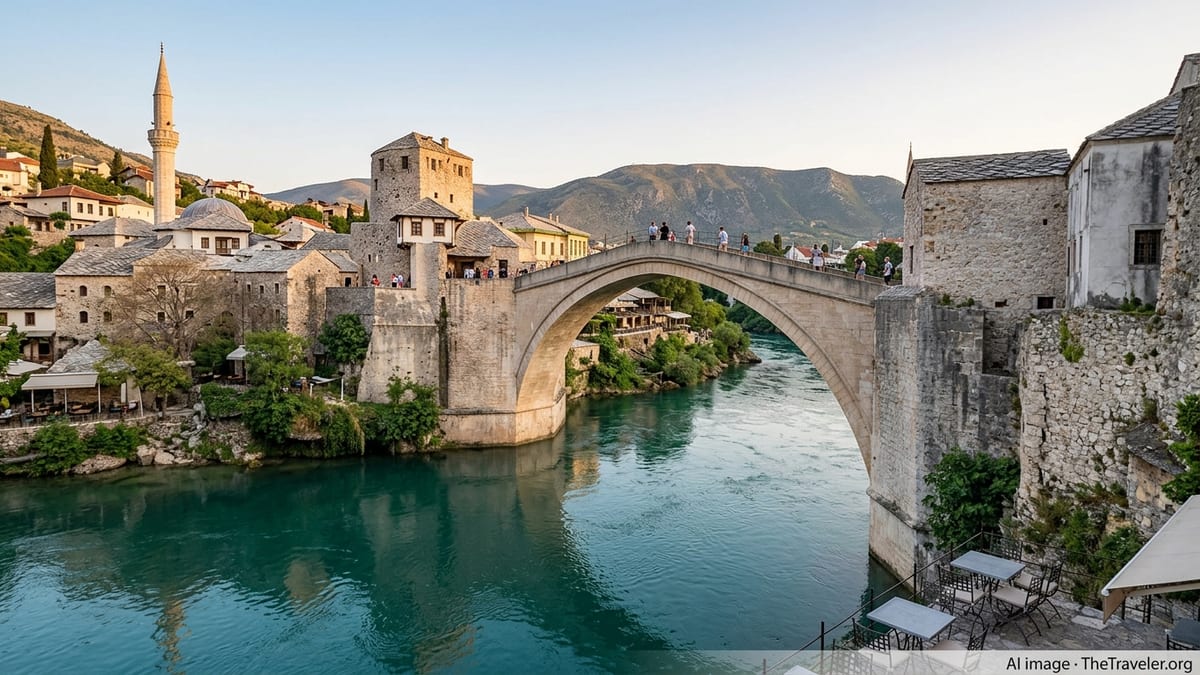
Faced with the choice between world‑famous Dubrovnik and lesser‑known Mostar, I picked the underdog. It changed how I travel, and I would do it again.
When a Dream Destination Starts to Feel Like a Theme Park
My relationship with Dubrovnik began long before I ever walked its marble streets. Friends came back raving about sunrise walks along the medieval walls and seafood dinners overlooking the Adriatic. Travel magazines crowned it the Pearl of the Adriatic. By the time I arrived in Croatia one June, Dubrovnik felt less like a city and more like an expectation I needed to fulfill.
The reality was impressive and exhausting in equal measure. By 10 a.m., the Old Town’s Stradun was a slow river of tour groups following raised umbrellas. Souvenir shops spilled magnet racks into the alleys. Restaurant hosts stood with laminated menus in six languages, steering people into identical terraces. I heard more English and German than Croatian. I paid city-wall admission with contactless card and shuffled counterclockwise with a solid line of other visitors, stopping when the group in front stopped to take the exact same photo.
None of this made Dubrovnik a bad place. Standing on the walls, looking out at Lokrum Island, was genuinely spectacular. But I could not shake the feeling that the city was bending itself around tourism more than it was inviting me into its own life. Cruise ship schedules dictated the rhythm of the streets. Beach clubs advertised bottle service in bold English, and small groceries carried just enough basics for short-term visitors. At my guesthouse, my host sighed when I asked how summer had been. “Busy,” she said, then paused. “Too busy. For you as tourists, and for us.”
That night, scrolling through train times and bus routes, I saw the same pattern in my plans: famous places strung together like beads. Plitvice Lakes, Split, Dubrovnik, maybe Kotor. Each one a name that would be recognized instantly back home. I had two free days before my flight and a choice to make. The glossy option was to stay in Dubrovnik and join the armada of day trips along the Croatian coast. The other option was a three-hour journey inland to a city with a bridge I had seen only occasionally in travel features: Mostar.
The Quiet Pull of a Less Famous Name
Mostar did not have the same spotlight reputation. I knew it had an old Ottoman bridge arcing over a turquoise river and that it had been badly damaged in the 1990s war. That was about it. Friends who had driven through Bosnia mentioned it as “a good stop for lunch” or “worth a quick look.” Guidebooks gave it a few pages, compared with full chapters on Dubrovnik’s city walls and Game of Thrones filming locations.
Yet the more I read, the more that modesty appealed to me. Photos showed stone houses climbing the banks of the Neretva River, minarets rising between red roofs, and market stalls shaded under low wooden awnings. Accommodation prices were markedly lower than on the Croatian coast. For the cost of a basic room in Dubrovnik’s outskirts, I could stay in a family-run guesthouse within walking distance of Stari Most, the rebuilt Old Bridge, with breakfast included and money left over for cevapi and coffee.
Logistics, too, made the choice surprisingly easy. Several daily buses connected Dubrovnik and Mostar, and although crossing the border into Bosnia and Herzegovina added some uncertainty to the schedule, travelers I spoke to in the hostel common room described the journey as scenic rather than stressful. They talked about the landscape changing from coastal scrub to dramatic limestone mountains and valleys, and about stepping off the bus into a city that felt immediately different in rhythm and sound.
What tipped me over the line was a simple realization: I could spend two more days in a place that already felt crowded and satisfied, or I could give that time to a city still stitching together its story, one that most people I knew had never seen beyond a postcard of a single bridge. Curiosity, in the end, was stronger than the pull of the famous name.
Arriving Where the Scars Are Still Visible
The road into Mostar wound along the Neretva, the river glowing an improbable shade of blue-green even under a hazy sky. At the small bus station, there was no tide of taxis or pre-booked tour coaches waiting. A couple of drivers leaned on the hoods of their cars, chatting quietly, and one ambled over when he saw the cluster of passengers looking at their phones. “Old town?” he asked. A short ride later, I was rolling my suitcase over uneven cobbles.
Mostar’s first impression was not polished. On the way from the station, we passed apartment blocks still pocked with shrapnel marks, blank concrete walls patched but not entirely healed. Grass pushed up between paving stones. Laundry hung from balconies beside satellite dishes. The city looked lived in, not staged. Turning into the historic center, the atmosphere shifted: narrow lanes paved with rounded river stones, low stone houses with slate roofs, and the rising curve of Stari Most itself, gleaming pale over the water.
The Old Bridge is the undisputed centerpiece, but in person it feels less like a single attraction and more like a spine connecting the two sides of the city. Standing on its slick surface, worn smooth by centuries of footsteps, I watched local divers gather tips from passersby before hurling themselves into the river below. Tourists paused for photos, but there was also a steady stream of locals simply crossing to run errands or meet friends. On one side, a call to prayer drifted from the Koski Mehmed Pasha Mosque; on the other, the bells of a Catholic church answered. The layers of identity were audible, not just visible.
Later that afternoon, wandering beyond the postcard viewpoints, I found small cafes where the prices were scrawled in marker on whiteboards and the clientele was almost entirely local. In one, the owner set down a tiny cup of thick Bosnian coffee and an equally tiny glass of water, then asked in patient English where I was from. When I said “I came from Dubrovnik,” he smiled. “Ah, the big star,” he said. “And now you see something different.”
What I Gained By Letting Go of the Big Name
Choosing Mostar over a longer stay in Dubrovnik did not give me more bragging rights. If anything, it took them away. Back home, when someone asked about my trip to Croatia, they wanted to hear about the walls and the sea kayaks and that famous staircase where crowds once gathered to reenact a television scene. Saying “I spent my last days in Bosnia instead” often led to a pause and a puzzled look.
Yet personally, those days in Mostar were the emotional center of the journey. They slowed my pace. With no list of iconic photo spots to tick through, I was free to let the days stretch. One morning I climbed to the terrace of the Koski Mehmed Pasha Mosque and sat alone for nearly half an hour, looking down at the bridge and the houses clustering the riverbanks. Another afternoon I walked fifteen minutes out of the historic core and found a park where teenagers kicked a football around improvised goalposts while older men played chess under the trees.
Conversations shifted, too. In Dubrovnik, most small talk with locals had revolved around tourism: how busy the season was, how high the rents had climbed, how early the cruise guests arrived. In Mostar, people still talked about visitors, but they also talked about staying. One taxi driver pointed out buildings that had been rebuilt since the war, and ones that still waited. A student I met in a cafe described growing up in a city that attracted foreign attention mainly on day trips, and how she wished more people stayed overnight to see the evenings, when the tour buses were gone and the riverfront restaurants filled with local families.
Practically speaking, the choice also stretched my budget further than another couple of days on the Croatian coast would have. Meals in Mostar cost noticeably less than the seafood dinners lining Dubrovnik’s harbor. Portions were generous, portions of grilled meat arriving with baskets of bread and salads piled with tomatoes and peppers. Coffee breaks did not feel like small financial decisions. It was possible to say yes to an extra dessert or a second drink without silently converting the price back into my home currency.
How Choosing the Underdog Changed The Rest of My Travels
Leaving Mostar, I realized that something subtle had shifted in how I approached trip planning. Until then, I had treated lesser-known destinations as add-ons to the main event, the way Mostar is often packaged as a day trip from Dubrovnik. Choosing it as the destination in its own right, at the expense of extra time in a famous city, rewired that logic.
On later trips, that new instinct showed up again and again. When I visited the Italian Riviera, for example, I skipped staying inside the most photographed villages of Cinque Terre and based myself instead in Levanto, a quieter town just beyond the national park boundary. The trains still whisked me to Vernazza and Manarola in under fifteen minutes, but at night I came back to a long local beach, a main street lined with bakeries and bike shops, and restaurant terraces where conversations were mostly in Italian. The pattern felt familiar: step into the center of fame during the day, retreat to somewhere more grounded at night.
The same thing happened in the Netherlands, where it would have been easy to focus solely on Amsterdam’s canals and museums. Instead, I spent an evening in a smaller village near Giethoorn, the so-called Dutch Venice, and watched locals navigate narrow waterways by small boats on their way home from work, long after the tour groups had driven away. The details changed, but the lesson held: choosing the less trumpeted place did not mean giving up on beauty or interest. Often it meant discovering them without the filters of crowds and commerce.
Mostar, though, remains the clearest example because it involved saying no to a globally recognized name in favor of a city whose story is still being written, and whose scars remain visible alongside its attractions. It reminded me that travel does not always have to follow the gravitational pull of the most shared images. Sometimes the most memorable days come from stepping deliberately to the side.
Practical Reflections for Travelers Facing the Same Choice
If you find yourself in Dubrovnik with a couple of spare days and the familiar temptation to simply stay where you are, it is worth asking what you hope to remember most vividly when you get home. If you want more sun-drenched afternoons on polished stone streets, a longer stay in the city will deliver that in abundance. If, on the other hand, you are curious about the region’s complexity, about how borders and histories have shaped neighboring countries differently, then giving some of your itinerary to a place like Mostar can bring those questions into sharp focus.
Logistically, it is achievable on a typical trip. Buses link the two cities in a journey that often takes around three to four hours depending on the border. While it is possible to visit Mostar as a long day trip, staying overnight deepens the experience. The city is noticeably quieter in the early morning and late evening, when the majority of tours have returned to the coast, and the rhythm of daily life becomes more visible.
Safety is a common concern when people hear the word Bosnia and remember news footage from the 1990s. On the ground, central Mostar today feels no more intimidating than other European cities of a similar size. Usual travel common sense applies, of course, but what stands out far more than any sense of risk is the warmth of local hospitality and the openness with which people talk about their recent history. Walking through the small war museum near the Old Bridge or joining a guided walk that explains the conflict’s impact on the city adds a layer of understanding you will not find in Dubrovnik’s polished alleys.
There is also a broader travel principle at stake. When we cluster in the same few famous destinations, we concentrate both money and pressure there, contributing to crowds that can strain local infrastructure and fray residents’ patience. Spreading some of that attention to nearby cities and towns helps distribute the benefits of tourism more evenly. It is not a complete solution to overtourism, but on an individual scale, choosing a place like Mostar over a fourth night in Dubrovnik aligns the personal rewards of travel with a slightly lighter footprint.
The Takeaway
Standing on the Old Bridge in Mostar at sunset, watching the Neretva darken beneath my feet, I did not miss the ramparts of Dubrovnik. I thought instead about how quickly travel can become a pursuit of recognizable backdrops, and how easy it is to forget that entire worlds exist a few hours away from the main stage.
Choosing Mostar over more time in Dubrovnik did not give me a longer checklist of famous sights. What it gave me was space to listen, to notice, and to feel my own assumptions about the Balkans dissolve into more complicated, more human stories. It reminded me that sometimes the bravest and most rewarding travel decision is not about going further, but about looking just to the side of where everyone else is looking.
If you ever find yourself torn between extending your stay in a famous city or diverting to a less heralded neighbor, remember that you are not choosing between “real travel” and a consolation prize. You are simply deciding which stories you want to bring back. For me, the quiet streets and resilient spirit of Mostar will always outweigh an extra day in the spotlight, and I would make that choice again in a heartbeat.
FAQ
Q1. Is Mostar a realistic alternative to spending more days in Dubrovnik?
Yes. Mostar offers a very different experience, but it is a compelling alternative if you are interested in history, culture, and a slower pace rather than more time in a busy coastal city.
Q2. How many days should I spend in Mostar instead of Dubrovnik?
One overnight stay in Mostar is the minimum to feel the city beyond day-trip crowds, but two nights allow time for unhurried wandering and nearby side trips.
Q3. Is it difficult to travel from Dubrovnik to Mostar on public transport?
It is manageable. Several buses typically run between the cities, and while border checks can add time, the route is straightforward and commonly used by travelers.
Q4. Is Mostar safe for solo travelers?
Central Mostar feels generally safe for solo visitors who take standard precautions, such as avoiding poorly lit areas late at night and keeping valuables secure.
Q5. Will I miss out by spending fewer days in Dubrovnik?
You may skip some coastal activities or museum visits, but you gain insight into a neighboring country and a very different side of the region’s story.
Q6. Are costs in Mostar lower than in Dubrovnik?
Typically yes. Accommodation, food, and everyday expenses in Mostar are often noticeably lower than in Dubrovnik’s Old Town and immediate surroundings.
Q7. Do people in Mostar speak English?
In the historic center and in most guesthouses, cafes, and restaurants, you will usually find staff who speak enough English to help with everyday needs.
Q8. Is Mostar only about the Old Bridge, or is there more to see?
The Old Bridge is the landmark, but there are also mosques with panoramic terraces, small museums, local markets, and neighborhoods that show daily life beyond the postcards.
Q9. Can I visit Mostar as a day trip and still benefit from going?
A day trip is better than not going at all, but an overnight stay makes a big difference, especially in the early morning and evening when the city feels more local.
Q10. What kind of traveler is Mostar best suited for?
Mostar suits travelers who value culture, conversation, and reflection over long lists of major sights, and who are curious about the region’s recent history as well as its beauty.